Zone Forge turns your soil samples into variable-rate prescription maps that ship straight to your platform — built on published university science, with every rate, every formula, traceable back to the source.
Pick your state — your recommendation cites your state's land-grant publication, not a national average.
Try the free lime calculator →
The problem with precision ag today
Most tools ask you to trust the algorithm.
Black-box recommendations. Hidden formulas. No way to check the math against your own soil tests. And mismatched extractant methods that silently bias rates by 20–40 lb per acre.
Farmers deserve software that shows its work — not software that asks for blind faith.
States with a calibrated land-grant source mapped — 40+ extension publications, your state cited, not a national average
14
Nutrients supported — N, P, K, S, Mg, Ca, Zn, B, Fe, Mn, Cu, Mo, Cl, Na
5
Soil-test classes (Very Low → Very High) auto-mapped to product rates
100%
Auditable — every rate traceable to a published university source you can verify.
What you get
Everything you need from soil sample to field application.
50-state extension calibration
Pick your state — Zone Forge auto-resolves the right calibrated source. Penn State Mehlich Buffer, UDel Adams-Evans, UGA Ca(OH)₂ titration, Cornell Modified Mehlich, Iowa PM 1688, Tri-State 2020, OSU's brand-new October 2025 Sikora tables, and 30+ more land-grant publications. Every critical level and removal factor cites the state's published extension paper — not a national average.
Graded soil-health report card
Upload a soil test and get back a plain-English report card — your worst nutrients first, color- and word-coded the way your own state university rates them. In 26 states we grade in your extension's exact wording (Arkansas's “Very Low → Above Optimum,” Delaware's Fertility Index, Oklahoma's “Low / Sufficient”). In the other 24 we honestly show the measured value with a note on why that lab format isn't graded yet. pH and lime are calibrated for all 50 states. We never print a wrong grade.
Phosphorus extractant enforcement
Auto-detects whether your lab used Mehlich-3, Bray-P1, or Olsen — and refuses to mix them silently. No more 20-40 lb/ac drift from mismatched calibrations.
Three philosophies, one click
Sufficiency, Build-and-Maintain, or Hybrid — choose the strategy that fits your tenancy, soil-test history, and budget. The math behind each is fully documented.
Stacked Litter → Potash → Nitrogen workflow
Three linked Rxs from one wizard pass. Enter a litter analysis, pick P-demand or N-demand, set caps. The engine sizes tons-per-acre litter, subtracts the K and N credits per zone, and ships three industry-standard shapefiles. Edit any input — all three layers recompute.
Blend several products in one pass
Assign two or three dry or liquid products to the nutrients they carry and generate the prescriptions together. Keep them as separate variable-rate layers — the default, so each nutrient is placed exactly to its own soil test — or spread them as one blended bag at a single field-wide ratio. Either way it lands on John Deere as a Map Layer you can view in Operations Center and a file your equipment can pull for Wireless Data Transfer.
Click-to-reassign zones
Tap any contour on the prescription map to bump it to a different zone. Field totals and acre-weighted costs update live. Five-second undo for accidental taps.
Direct to your platform
OAuth-authenticated push to your platform. Validates the shapefile, polls upload status, and gracefully recovers from platform outages with one-tap retry — without losing your local Rx.
Local cash bids on your crop
Tap the crop on your field map and see today's USDA local cash bid for your area — the real elevator price near you, not a national number. Growing a contract or specialty crop with no public bid? Set your own price once in the Price Book and it shows the same way. (Where there's a live USDA bid, it always wins — your price only fills the gaps.)
Spray-window advisory, by field
Standing at the field edge wondering if you can spray? Each field gets a plain-language read on the hour — good, marginal, or hold off — from its own forecast: wind and gusts, Delta-T, rain, and rainfast risk, with National Weather Service alerts layered in. If now's no good, it points you to your next window. It's an advisory to help you plan, not a guarantee — your eyes on the field still make the call.
Team chat with field context
Talk to your crew inside the app. Drop a field card into a bubble and they see its shape, acres, crop, last work, Rx-readiness — without leaving the message. Voice messages (with on-demand transcription), group chats, contacts beyond your John Deere org, "at North 40" presence. The radio's job, in your pocket. See team features →
Sample-to-lab kit
Other tools end at the "all samples collected" banner. Zone Forge gets your samples to the lab. Print Avery labels with QR codes before the field, tap "Bag it" after each sample, pick from six US labs (Waters, A&L, Ward, Spectrum, Midwest, Brookside) and download a pre-filled submission form, buy a UPS or FedEx Ground label billed to your own account, and get an email + push notification when the lab receives the cooler. Five minutes instead of forty. See the workflow →
Earning your trust
Every number Zone Forge prints is auditable.
We don't ask you to trust an algorithm. We ask you to read the math, check the source, and reproduce it on the back of an envelope. If you can't, we haven't done our job.
Published, cited tables. Every recommendation traces to a named extension publication with a calibration year.
Deterministic formulas. Same inputs always produce the same rate. No machine-learning black boxes, no proprietary "secret sauce."
Soft data warnings. Stale samples, sparse coverage, lab outliers — flagged with context, never silently swallowed or used to hard-block your work.
Placeholder values flagged. Numbers we infer (vs. cite) are explicitly marked verified: false so you know which to scrutinize.
Printable field reports. One-page PDF with map, per-zone table, sources, and your inputs — hand it to your agronomist, retailer, or banker.
From soil report to field application in four steps.
01
Upload your soil samples
Drag in a CSV from your lab. Zone Forge auto-detects lat/lon, pH, P, K, organic matter, CEC, and any micronutrient columns. Visualize as points, heatmap, or hotspot — clipped to your field boundary.
02
Pick your source & philosophy
Choose the regional table that matches your lab method. Pick Sufficiency for cheap rented ground, Build-and-Maintain for owned acres, or Hybrid for a balanced approach.
03
Review and adjust zones
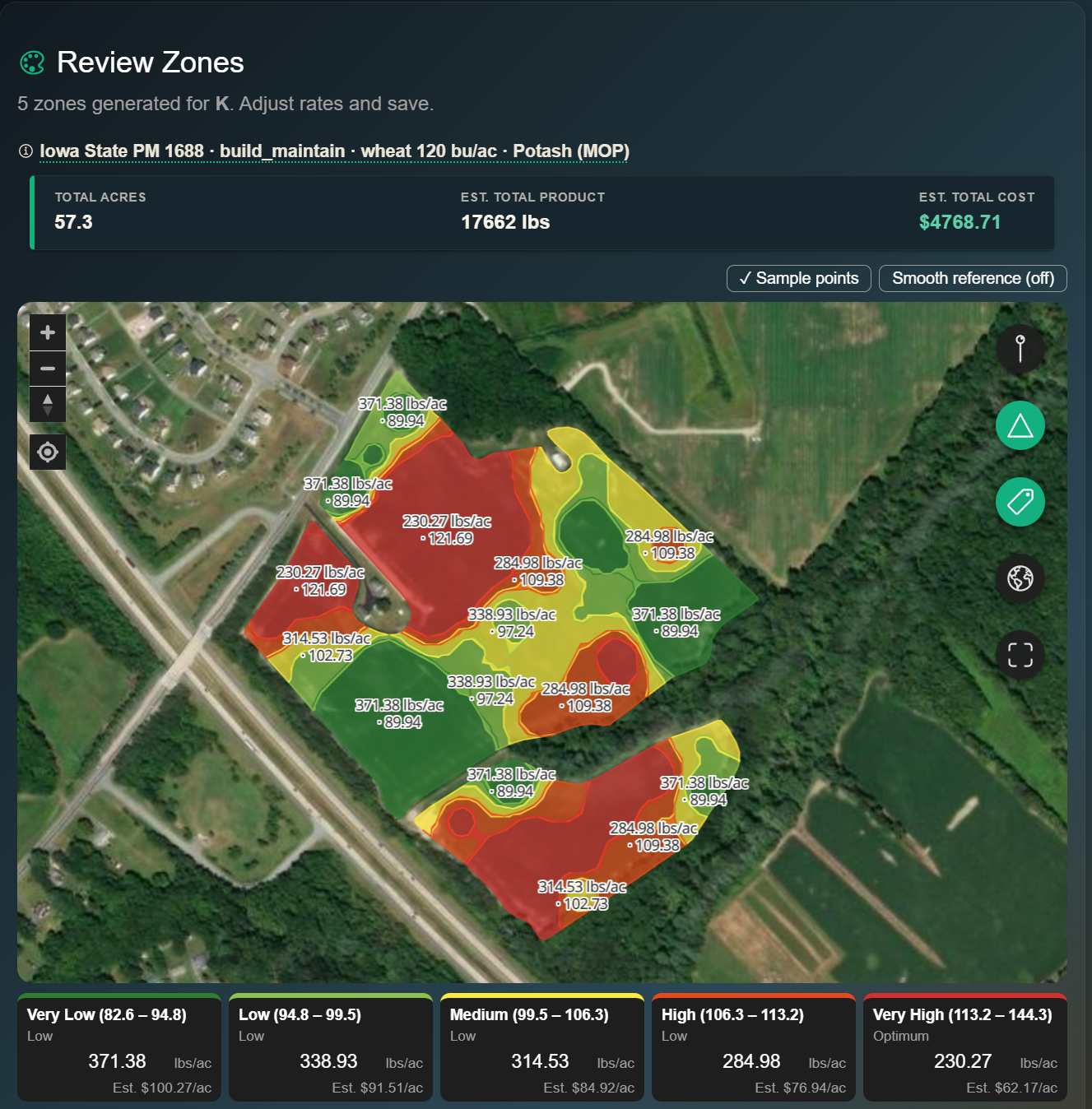
See five color-coded zones with product rates, acres, and live cost-per-acre. Tap any contour to reassign it. Edit rates inline. Field totals update on every keystroke.
04
Push to your platform
One tap exports a validated shapefile to your platform. Live status polling. If the platform's API hiccups, your Rx stays safe locally and you retry with a single button.
Zone Forge talks directly to your operations platform via official platform APIs. OAuth handshake, token refresh, four-step upload pipeline — all handled. Your prescriptions show up on your display, ready to apply.
OAuth 2.0 with 365-day refresh — sign in once, stay signed in
Auto-validates shapefile schema before upload (Rate field, polygon geometry, EPSG:4326)
Live upload status — QUEUED → VALID with retry on partial failure
Soil heatmaps and prescriptions both supported — full platform visibility
Upload pipeline
✓POST mapLayerSummaries204ms
✓POST mapLayers (legend + extent)187ms
✓POST fileResources142ms
✓PUT shapefile.zip (binary)1.2s
●Polling validation status…VALID
FOR AGRONOMISTS
Manage many client farms from one login.
If you're a crop consultant, ag retailer, or independent agronomist serving
multiple growers, Studio is your tier. White-labeled Rx PDFs with your
brand, JD Map Layers + Files API push that your client's equipment can actually
read, full audit log per client. $499/year or
$19/month per active client below Operator — Operator & Enterprise
clients are $0 either way. Published, not "contact sales."
Sign up, upload a CSV, generate your first prescription in under five minutes. No credit card required — and every price, including Studio, is published up front.